
When someone is arrested in California, one of the first questions their family asks is: how do we get them out? The answer depends on which release option applies — and understanding the differences between cash bail vs. surety bond vs. own recognizance can help you act quickly and make the right financial decision for your situation. At Bright Bail Bonds, we serve all of Southern California 24/7, and we walk families through these options every day. Here is a clear, honest breakdown of how each one works, what it costs, and who it’s best suited for.
Three Ways to Be Released From Jail Before Trial in California
California law provides three primary pathways for a defendant to be released from custody while their case moves through the court system. Each one is fundamentally different in terms of who controls the outcome, what it costs, and what conditions come with it:
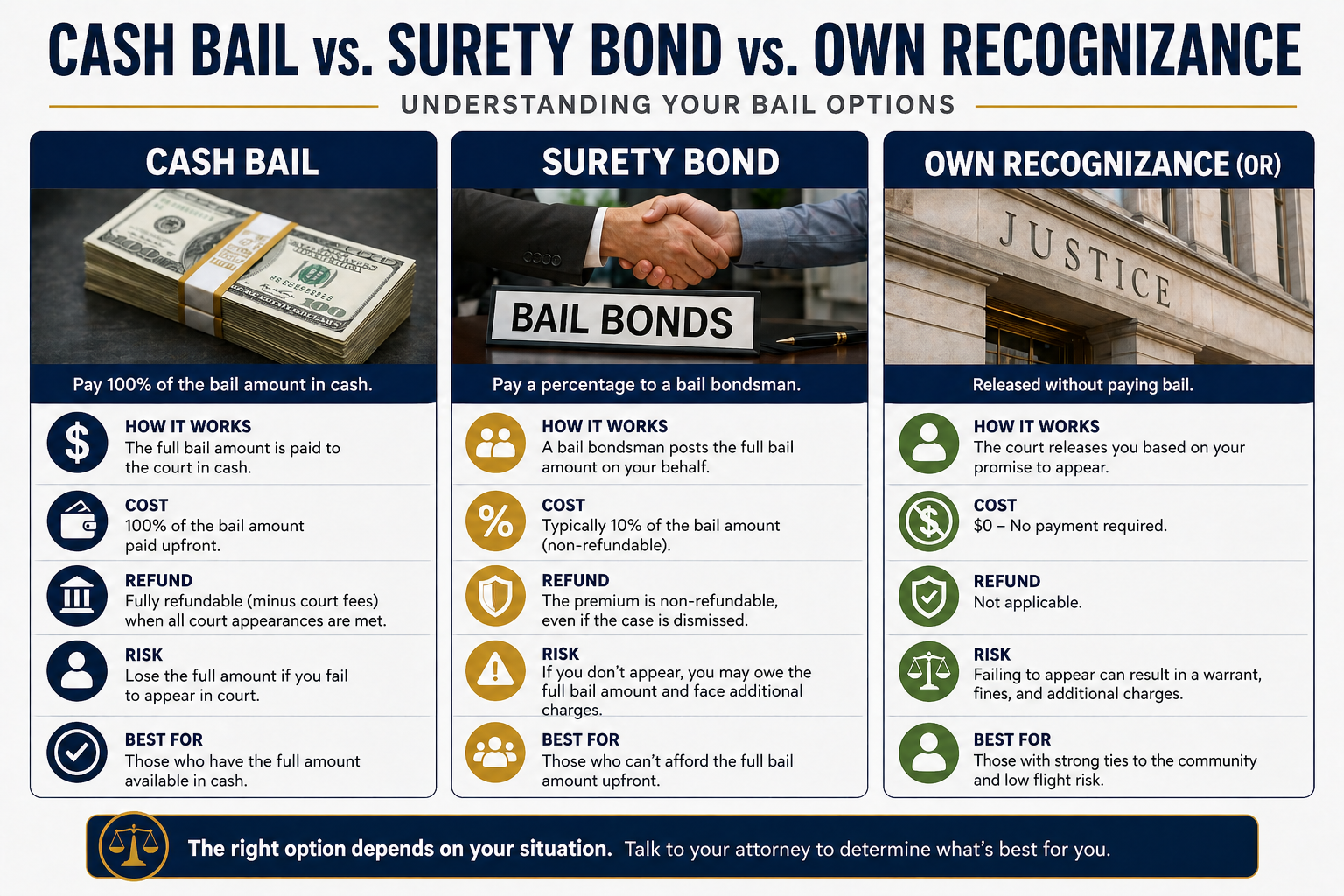
- Cash bail — You pay the full bail amount set by the court directly, in cash.
- Surety bond — A licensed bail bondsman posts the full bail amount on your behalf in exchange for a non-refundable premium, typically 10% of the total.
- Own recognizance (OR) release — The judge releases the defendant based on a written promise to appear, with no money required from anyone.
There are other options — such as property bonds — but these three are the ones most California families will encounter. Understanding each one clearly is the starting point for making the best decision when time is short and the stakes are high.
Cash Bail: The Straightforward Option — If You Can Access the Full Amount

Cash bail is exactly what it sounds like. The court sets a bail amount based on the charges and the defendant’s background, and someone — the defendant, a family member, or a friend — pays that entire amount directly to the court or jail to secure the defendant’s release.
If bail is set at $25,000, the full $25,000 must be paid. In return, the defendant is released and the case proceeds. Once all required court appearances are completed and the case is resolved, the court returns the money — minus any administrative fees — regardless of the verdict.
Cash bail works well in a narrow set of circumstances:
- The bail amount is relatively low (a few hundred to a few thousand dollars)
- The family has immediate access to liquid funds in the full amount required
- The defendant has a strong preference to recoup the money after the case ends
The major drawback is obvious: most California bail amounts are set far higher than what a typical family can produce in cash on short notice. Bail for felony charges frequently runs from $20,000 to $100,000 or more. Even for misdemeanor charges, coming up with the full amount overnight is beyond reach for most people. And while the money is theoretically refundable, it remains tied up and inaccessible for the entire duration of the case — which can stretch on for months or even years.
Surety Bonds Are the Most Common Route Out of Jail in California
A surety bond — what most people simply call a “bail bond” — is the option the majority of California families turn to when cash bail isn’t affordable. It involves three parties: the defendant, the court, and a licensed bail bond company acting as the surety.
Here’s how it works: instead of paying the court the full bail amount, you pay a licensed bail bondsman a non-refundable premium — in California, this is set by law at a minimum of 10% of the total bail amount. In exchange, the bail bond company posts the full bail amount with the court on the defendant’s behalf, guaranteeing their appearance at all scheduled court dates. The defendant is released. The case proceeds.
On a $25,000 bail, you pay the bondsman $2,500 rather than $25,000 to the court. That $2,500 is not returned — it is the bondsman’s earned fee for posting the bond and taking on the financial risk. But it gets your loved one home tonight, not in six months after a case resolves.
Surety bonds are the most practical option for most families because:
- The upfront cost is a fraction of the total bail amount — 10% versus 100%
- Payment plans are available — qualifying families can often arrange zero down or low down payment plans, spreading the premium over time
- The process is fast — an experienced bail agent can post the bond the same day, often within hours of the initial call
- It works for most charge types — misdemeanors, felonies, DUI, domestic violence, and more
At Bright Bail Bonds, we handle 100% of the process online, meaning no one needs to drive to an office in the middle of the night. Documents are signed electronically, and we follow up directly with the facility to help move the release along as quickly as the system allows.
Own Recognizance Release Costs Nothing — But It Isn’t Yours to Choose
An own recognizance (OR) release — sometimes called a release on recognizance, or ROR — is the most financially favorable outcome for a defendant. No money changes hands. The defendant signs a written promise to appear at all future court dates and is released from custody on that promise alone.
The critical thing to understand about OR release is that it is entirely at the judge’s discretion. You cannot apply for it, pay for it, or guarantee it. The judge determines whether to grant it based on factors that include:
- The nature and severity of the charges
- The defendant’s prior criminal history and any history of failure to appear in court
- Ties to the community — local residence, family, employment, length of time in the area
- Whether the defendant is considered a flight risk or a danger to public safety
- The defendant’s ability to pay bail (under California’s In re Humphrey standard, judges are required to consider financial circumstances when setting bail conditions)
OR release is most commonly granted for lower-level offenses, first-time arrests, and defendants with strong community roots and no prior failures to appear. It is rarely available for serious or violent felonies. Even when OR is granted, the court may attach conditions — such as regular check-ins with a pretrial services officer, travel restrictions, or stay-away orders — that the defendant must comply with to remain out of custody.
The bottom line: if your loved one qualifies for OR release, that determination will come from the court, typically at arraignment. If OR is denied or unavailable, a surety bond through a licensed bail bondsman is the next most accessible option for the vast majority of families.
Which Release Option Applies to Your Situation?
Comparing the three options side by side helps clarify which path makes sense:
| Option | Who Controls It | Upfront Cost | Is Money Returned? | Best For |
|---|---|---|---|---|
| Cash Bail | You (if you can pay) | 100% of bail amount | Yes, minus fees, if defendant appears | Small bail amounts; families with immediate liquid funds |
| Surety Bond | You + bail bondsman | 10% of bail amount (non-refundable) | No | Most families; larger bail amounts; when speed matters |
| Own Recognizance | Judge only | Nothing | N/A | Minor offenses; first-time arrests; strong community ties |
For most families dealing with a bail amount above a few thousand dollars, the surety bond is the practical choice — it requires far less upfront, moves quickly, and works for the widest range of charge types and financial situations.
What Happens If the Defendant Fails to Appear in Court?
This question matters regardless of which release option is used, and the consequences are different for each:
With cash bail, if the defendant misses a court date, the court forfeits the entire bail amount. California law (Penal Code 1305) provides a 180-day window during which the defendant or their attorney can file a motion to vacate the forfeiture and reinstate bail if there is a valid reason for the absence — but if that window passes, the money is gone.
With a surety bond, the bail bond company becomes responsible for paying the full bail amount to the court if the defendant fails to appear. To protect against that loss, the bail bondsman has the right to locate and return the defendant to custody. The co-signer on the bond may also be held liable for the full bail amount and any recovery costs incurred. This is why the co-signer role carries serious financial responsibility and should be undertaken with a clear understanding of what it means.
With own recognizance release, failing to appear results in an immediate arrest warrant, revocation of the OR status, and potential additional criminal charges for the missed appearance. The defendant will typically be taken back into custody without the option of bail, or with a significantly higher bail set by the court.
In all three cases, appearing at every scheduled court date is the single most important obligation of the release agreement. If circumstances make attending a court date impossible, the defendant’s attorney should be notified immediately so a continuance can be requested before the absence occurs.
Frequently Asked Questions: Cash Bail, Surety Bonds, and OR Release
Can I switch from a surety bond to cash bail after my loved one is already released?
In theory, cash bail can be substituted for an existing surety bond, but doing so requires paying the full bail amount to the court, at which point the bail bond company’s obligation ends and the premium already paid is not refunded. In practice, there is rarely a financial reason to make this switch once a surety bond is already in place.
How does the court decide whether to grant OR release?
Judges weigh the defendant’s flight risk, danger to the community, prior criminal history, ties to the local area, nature of the charges, and ability to pay bail. Under California’s In re Humphrey standard, financial inability to pay is a factor the judge must consider — but it does not automatically result in OR release. The judge retains broad discretion in the final determination.
Does paying cash bail mean the charges are dropped?
No. Bail and criminal charges are completely separate. Paying bail — in any form — only secures the defendant’s release from custody while the case proceeds. It has no effect on the charges themselves, the prosecution’s case, or the outcome of the trial.
Can a bail bondsman refuse to post a surety bond?
Yes. Bail bond companies have the right to decline cases they consider too high a risk. Cases involving immigration (ICE holds) and most federal charges cannot be bonded through a standard surety bond and must be handled differently. If a bondsman declines your case, call another — requirements and risk tolerance vary between companies.
How long does it take to get released after a surety bond is posted?
Once the bond is posted, the release timeline is controlled by the jail’s processing speed, not the bail bond company. Some facilities complete processing in a few hours; others — particularly on nights, weekends, or during high-volume periods — can take longer. Bright Bail Bonds posts bonds as quickly as paperwork allows and follows up with the facility directly to help move the process along.
If you’re trying to figure out the right release option for someone who has just been arrested in Southern California, the fastest way to get a clear answer is to call us. Bright Bail Bonds is available 24 hours a day, seven days a week — including nights, weekends, and holidays. Call 888-669-0295 and we’ll explain your options honestly and help you move forward immediately.